
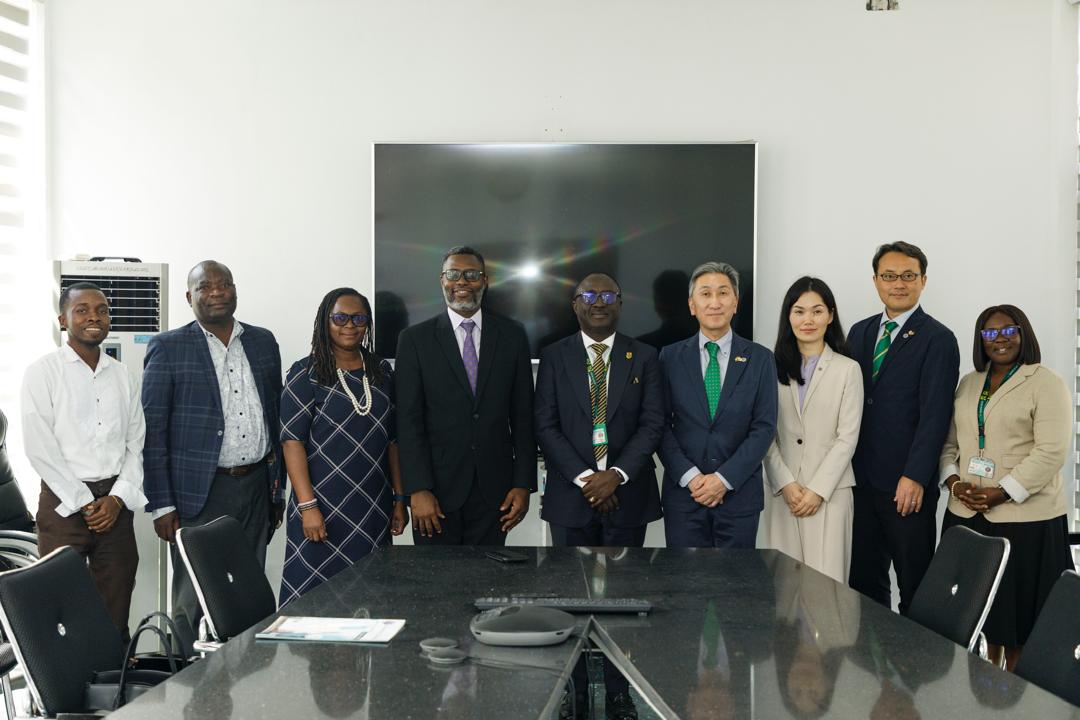
The Kwame Nkrumah University of Science and Technology (KNUST), Kumasi, has welcomed a delegation from the University of Tsukuba, Japan, to explore opportunities for collaboration in student-faculty mobility and exchange.
Prof. Edmund Ekuadzi, Dean of the International Programmes Office, revealed that the collaboration initially focused on student and staff exchange in public health, which later extended to the School of Nursing.
“The partnership already existed between the school of Public Health and Nursing, but now they are here to discuss possible opportunities outside of the engagements,” he noted.
The Vice President for Global Affairs, Dr Osamu Ohneda, highlighted the importance of cross-cultural learning.
He said that the exchange programs allow Japanese students rare opportunities to experience African contexts while Ghanaian students gain insights into Japan’s research landscape.
Dr Fukushige Mizuho, Vice Director, Bureau of Global Initiatives, said that while Japan hosts a significant number of international students, only fifteen of them are Ghanaian.
She explained that the initiative is to foster meaningful cultural exchange to gain global perspectives.
“We are located at the far east if you look at Japan from Ghana. To diversify our campus and promote greater cross-cultural engagement, we aim to roll out programmes that will enable more students from Ghana to study in Japan,”
Dr Masao Ichikawa revealed that a key feature of the collaboration will allow students from different universities to receive in-person training if selected.
He noted, however, that due to budget constraints, the program also includes an online component that will allow Ghanaian students to study remotely.
The Pro-Vice Chancellor of KNUST, Professor David Asamoah, emphasised that KNUST is committed to such international partnerships and is open to exploring additional avenues for collaboration.
“We value such partnerships, and we will establish the appropriate frameworks to ensure that the partnership remains productive and mutually beneficial for both institutions,” he said.
He encouraged them to expand their engagement across the university and look at other areas and faculties such as engineering, humanities, environmental sciences, and emerging fields like artificial intelligence (AI).


